Website design for holiday cottages
Guests often find you on Airbnb or Booking.com, then search your cottage's name to see if they can book direct. We build holiday let websites that win that moment with an all-in price, live dates and the detail platforms leave out.
How people choose holiday cottages
Booking platforms are where most guests discover a cottage, and they charge for it: Airbnb's host-only fee is around 15.5% for many UK hosts. Your own website is where repeat guests and name-searchers book without that cost.
Name-searchers
Found you on a platform and want to book direct. They need to trust the site, see the same property and the full price.
Returning guests
Loved their stay. Want to rebook their favourite week and to hear from you, not a platform.
Guests with specific needs
Dogs, accessibility, a ground-floor bedroom, enclosed garden, EV charging. They want precise answers.
Destination browsers
Searching for a type of stay in an area, such as a dog-friendly cottage on the Norfolk coast. Local guides help here.
Three journeys to design for
- Book directChecks dates, sees the all-in price, reads the terms and books or requests.
- Ask firstHas a question about dogs, access or a long stay. Wants to message the owner.
- RebookComes back from a post-stay email or the welcome book and books next year.
Features, in order of priority
What matters most for holiday cottages, why it matters, and which parts need a third-party service.
Essential
Every site in this sector should have these.
- Real photos of every room, with a sleeping list
Guests book on certainty. Show every room and say exactly who sleeps where.
Standard build - Live availability
Saves a round of emails and stops double bookings when it's synced with your platforms.
Third-party serviceComes from your channel manager or booking engine, which has its own monthly fee.
- All-in price from the first view
Since April 2025 the price you show must include charges every guest pays, such as a cleaning fee.
Standard build - Clear booking terms
Deposit, balance date, cancellation, damage deposit and house rules, in plain English, before booking.
Standard build - Honest accessibility details
Steps, door widths, bathroom layout, parking. Specific facts help every guest decide.
Standard build
Recommended
Worth it for most businesses.
- Why book direct
True reasons only: talk to the owner, flexible changes, a returning guest rate.
Standard build - Local guide
Walks, pubs, beaches and dog-friendly spots. Useful for guests and for search.
Standard build - Ask the owner
Many direct guests book because they can talk to the owner.
Standard build
Optional
Useful as you grow, often with extra cost.
- Instant online booking and payment
A booking engine takes secure payment and confirms straight away.
Third-party service - Returning guest list
A consented mailing list is the cheapest way to fill quiet weeks.
Third-party service
Where enquiries come from
Most cottages don't need to drop the platforms. The aim is to move name-searchers and repeat guests onto your own site, where you keep the booking fee and the relationship.
- Your property nameUse the same name everywhere, and make sure your site is the first result when people search it.
- Repeat guestsA welcome book link, a post-stay email (with consent) and a returning guest rate.
- Google free booking linksAvailable through some booking engines and channel managers. Google's rules for holiday rental profiles are strict, so we check what applies.
- Owner-direct and niche listingsLow-commission sites and dog-friendly or accessible directories that link to your site.
- SocialShort videos of the cottage and the area, linking to your dates.
Direct booking path
- Picks dates on the calendar
- Sees the all-in price
- Requests or books
Question first path
- Reads the house details
- Asks the owner
- Books after a reply

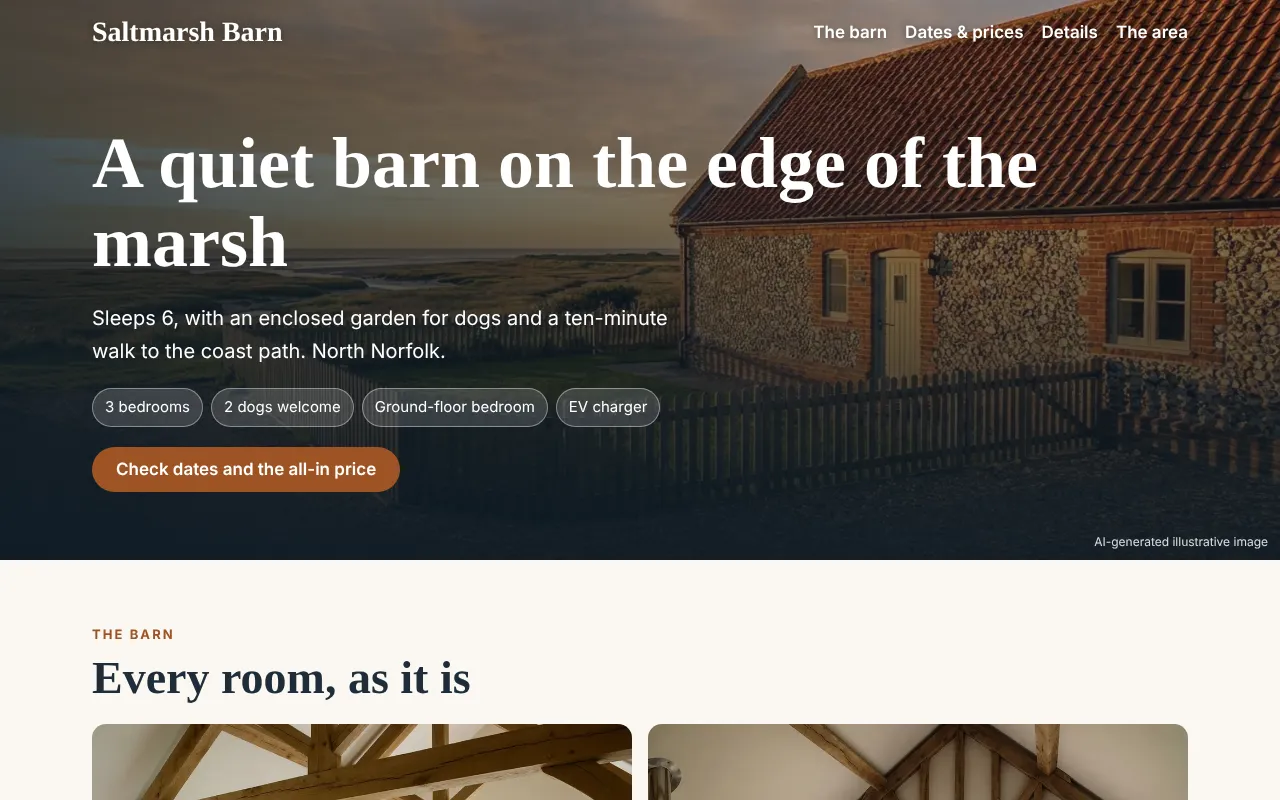
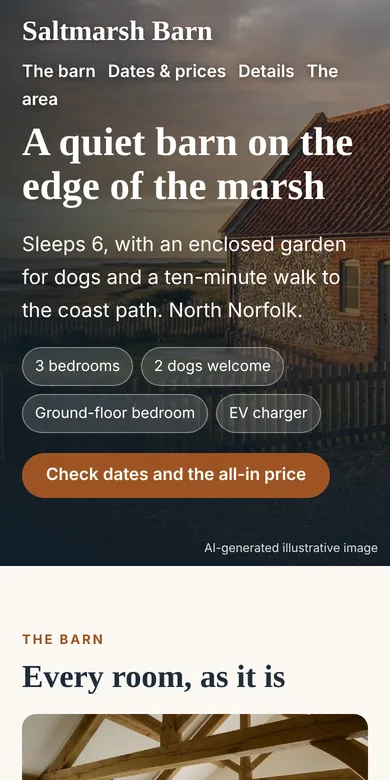
What it could look like: Saltmarsh Barn
Saltmarsh Barn is a made-up North Norfolk cottage. The concept shows how we would win the guest who has found you on a platform and searched your name to book direct.
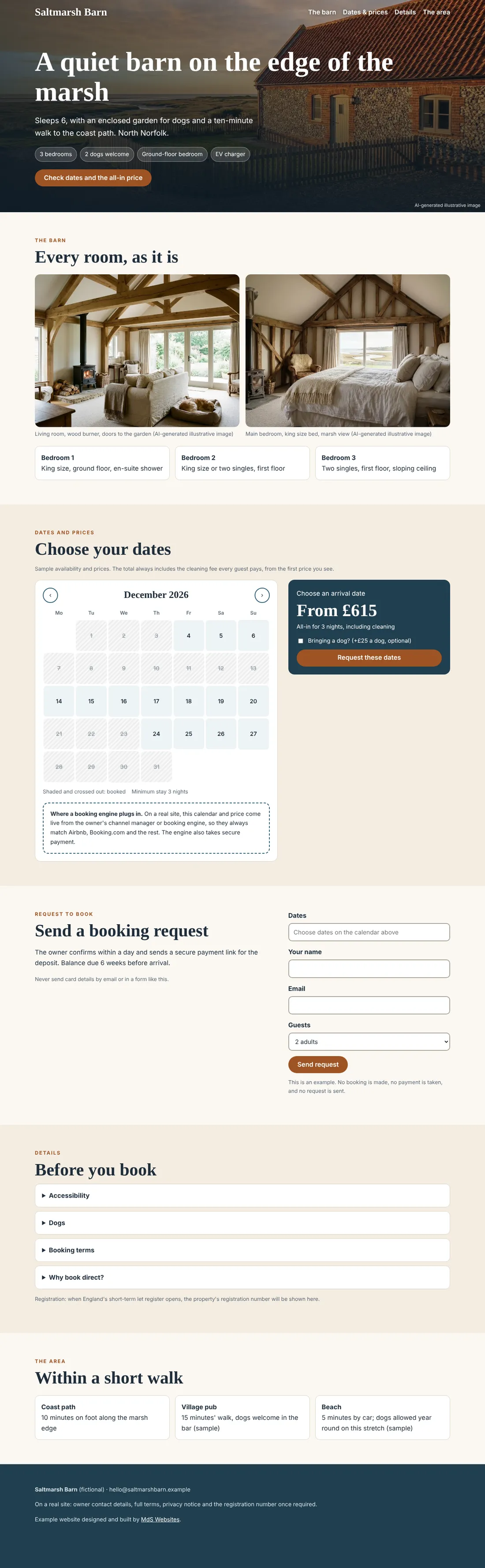
Scroll inside the frame to see the whole home page.
What the design puts first
- One all-in price, with the cleaning fee included from the first view
- Availability beside the price, fed by your channel manager in a real build
- Precise details: who sleeps where, steps, and fence heights for dogs
- True reasons to book direct, in the owner's own words
A concept to show priorities and style, not a finished site. Your website would be designed around your business, with all the pages and detail it needs.
What works, and what to avoid
Do
- Show the full price early
Nights plus any cleaning or booking fee in one number, before the guest has to commit.
- Describe the property precisely
Bed sizes, steps, fence heights for dogs, parking spaces. Detail is your advantage over a platform listing.
- Give true reasons to book direct
Talking to the owner, flexible changes or a returning guest rate. Only promise what you actually offer.
- Use one calendar for everything
A channel manager keeps your site and the platforms in sync, so there are no double bookings.
Don't
- Add a mandatory fee at the end
A cleaning or booking fee every guest pays must be in the headline price under the DMCC Act.
- Copy or write reviews
Fake reviews are banned, and platform reviews usually can't be copied onto your site. Collect your own.
- Take card details by email or a plain form
Use a booking engine or payment provider that handles card data securely.
- Claim "best price guaranteed" without checking
Make sure your pricing and platform terms actually allow it.
The rules that shape the site
Holiday lets are getting more regulated. These points shape the website. It's a planning summary, not legal advice, and some rules are still changing.
- All-in pricingLawUK
The DMCC Act banned drip pricing from April 2025. Mandatory fees and charges must be included in the price you first show. Source: Taylor Wessing
- Registration in EnglandLawEngland
A national register for short-term lets in England is coming. GOV.UK says it isn't in force yet; updated guidance points to March 2027. You'll probably need to show a registration number. Source: GOV.UK
- Scotland, Wales and Northern IrelandLawScotland, Wales, NI
Scotland requires short-term let licences, Wales is introducing a visitor accommodation register, and Northern Ireland requires Tourism NI certification. Source: Property Industry Eye
- Safety and insuranceLawEngland
GOV.UK lists fire, gas and electrical safety, suitable insurance and planning among the rules for self-catering lets. Source: GOV.UK
- Genuine reviewsLawUK
Fake reviews are banned under the DMCC Act. Only show genuine guest reviews. Source: Taylor Wessing
What we build, and what others provide
How these features fit into an MdS build. We quote after a free call; there are no prices here.
Gallery, sleeping list, terms, accessibility and local guide
Part of a standard MdS build, editable in Decap CMS.
Availability and booking
We connect the booking engine or channel manager you choose, or help you pick one. It has its own monthly fee.
Booking request form
Included for owners who prefer to confirm each booking themselves.
Search, Google and social
Through our digital marketing and SEO service.
Hosting and care
UK hosting, backups, updates and seasonal price changes on a care plan.
Questions holiday cottages ask us
Do I need a channel manager?
If you're on more than one platform and want live availability on your site, yes. It keeps one calendar in sync everywhere. If you only take a few direct bookings, a booking request form can work to start with.
Can guests pay on my website?
Yes, through a booking engine that takes payment securely. We don't build our own payment system or take card details by form.
Should I leave Airbnb and Booking.com?
Usually not. Platforms are good at finding new guests. Your website is for name-searchers and repeat guests, where you keep the fee.
How much does a holiday cottage website cost?
It depends on the number of properties and the booking set-up. We quote a fixed price after a free call, and explain the booking engine's own costs separately.
Can I change prices and dates myself?
Dates and prices come from your booking engine, which you control. Text, photos and the local guide are editable in Decap CMS.
What about the new registration scheme?
When England's scheme opens, we'll add your registration number to the site. We keep an eye on GOV.UK for the start date.
Related pages
Sources and further reading
- Taylor Wessing: DMCCA drip pricing: what businesses must comply with from 6 April 2025
- GOV.UK: Letting out a self-catering holiday home in England: rules and regulations
- Clyde & Co: England's short-let registration scheme: what the March 2027 launch means
- Property Industry Eye: Government announces date for new property register
- Travelnest: How to reduce Airbnb commission fees: a UK holiday let host's guide
Checked 27 November 2026. Rules change, so check the source before relying on it.
Let's talk about your holiday cottages website.
Book a free, no-pressure call. Tell us how you win customers now, and we'll show you what we'd change first.